
Overview
Simon Peter stands among the most familiar and influential disciples in the New Testament. He was a Galilean fisherman whom Jesus Christ called away from his nets and into a life of discipleship, witness, sacrifice, and spiritual leadership. The Gospels present him with unusual honesty. Peter could be courageous one moment and fearful the next, spiritually perceptive in one scene and painfully mistaken in another. His life shows that Christ does not call only those who are already polished and dependable. He calls ordinary people, exposes their weakness, teaches them through failure, and forms them into faithful servants by grace.
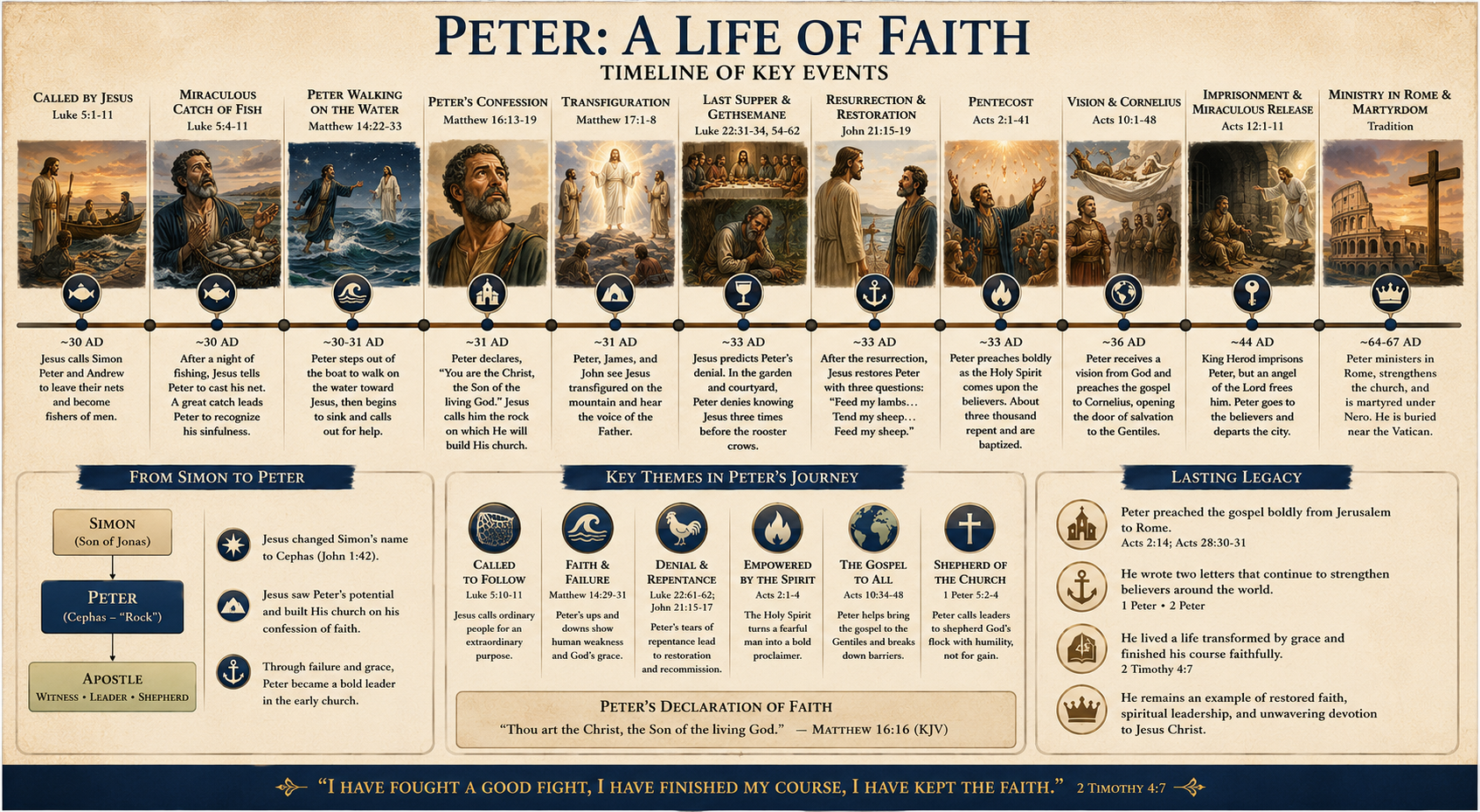
Peter’s original name was Simon, or Simeon. Jesus gave him the name Cephas, an Aramaic name translated into Greek as Peter, meaning a stone or rock. The name did not mean that Peter was naturally immovable. During the years recorded in the Gospels, he often acted impulsively and sometimes wavered under pressure. Rather, the name pointed toward what Christ intended to make of him. The Lord would transform an outspoken fisherman into a bold witness who preached Christ publicly, strengthened believers, endured persecution, and helped guide the early church.
Peter belonged to the inner circle of disciples who were permitted to witness several events that the others did not see. Along with James and John, he saw the raising of Jairus’s daughter, the transfiguration of Christ, and the Lord’s sorrow in Gethsemane. He frequently spoke on behalf of the Twelve and is named first in the apostolic lists. Yet his prominence did not spare him from correction. Jesus rebuked him sharply when he resisted the truth of the cross, rescued him when his faith failed upon the water, and restored him after he denied knowing the Lord.
After the resurrection and ascension of Christ, Peter emerged as one of the chief public witnesses in the opening chapters of Acts. He preached at Pentecost, proclaimed the resurrection before the Jewish rulers, participated in remarkable healings, and was used by God to open the door of gospel fellowship to Gentiles through the conversion of Cornelius. His ministry helped demonstrate that salvation in Jesus Christ was not confined to one nation, social class, or ceremonial boundary.
The New Testament also preserves two letters bearing Peter’s name. First Peter strengthens believers who suffer for their faith and directs them to the example, resurrection, and coming glory of Christ. Second Peter warns against false teachers, urges spiritual growth, and reminds the church that the promised return of the Lord is certain. Across the Gospels, Acts, and his epistles, Peter’s central message remains consistent: Jesus is the Christ, the Son of the living God; He suffered for sinners, rose from the dead, reigns in glory, and will return.
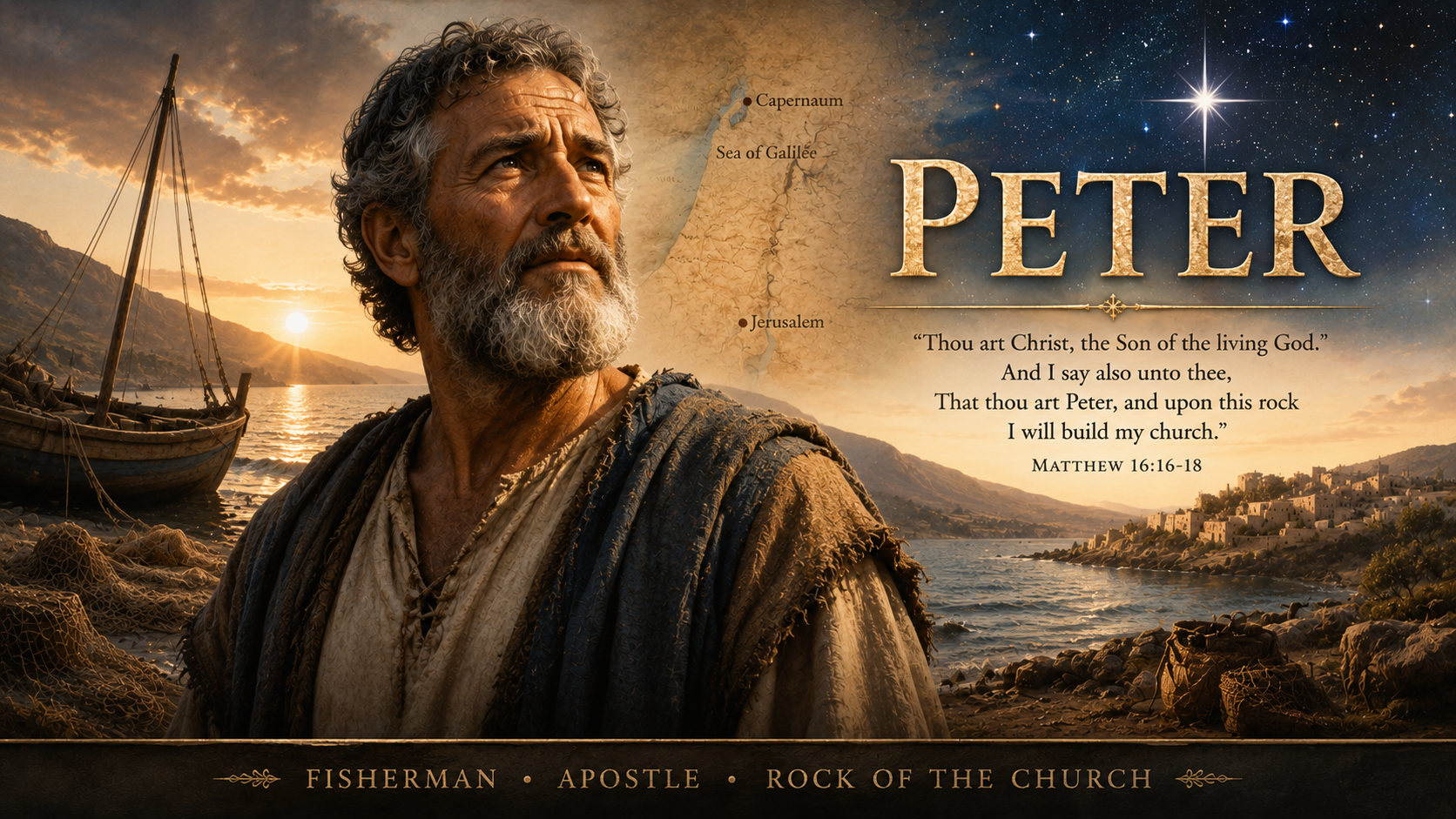
“Thou art the Christ, the Son of the living God.” — Matthew 16:16 (KJV)
Life at a Glance
A Fisherman from Galilee
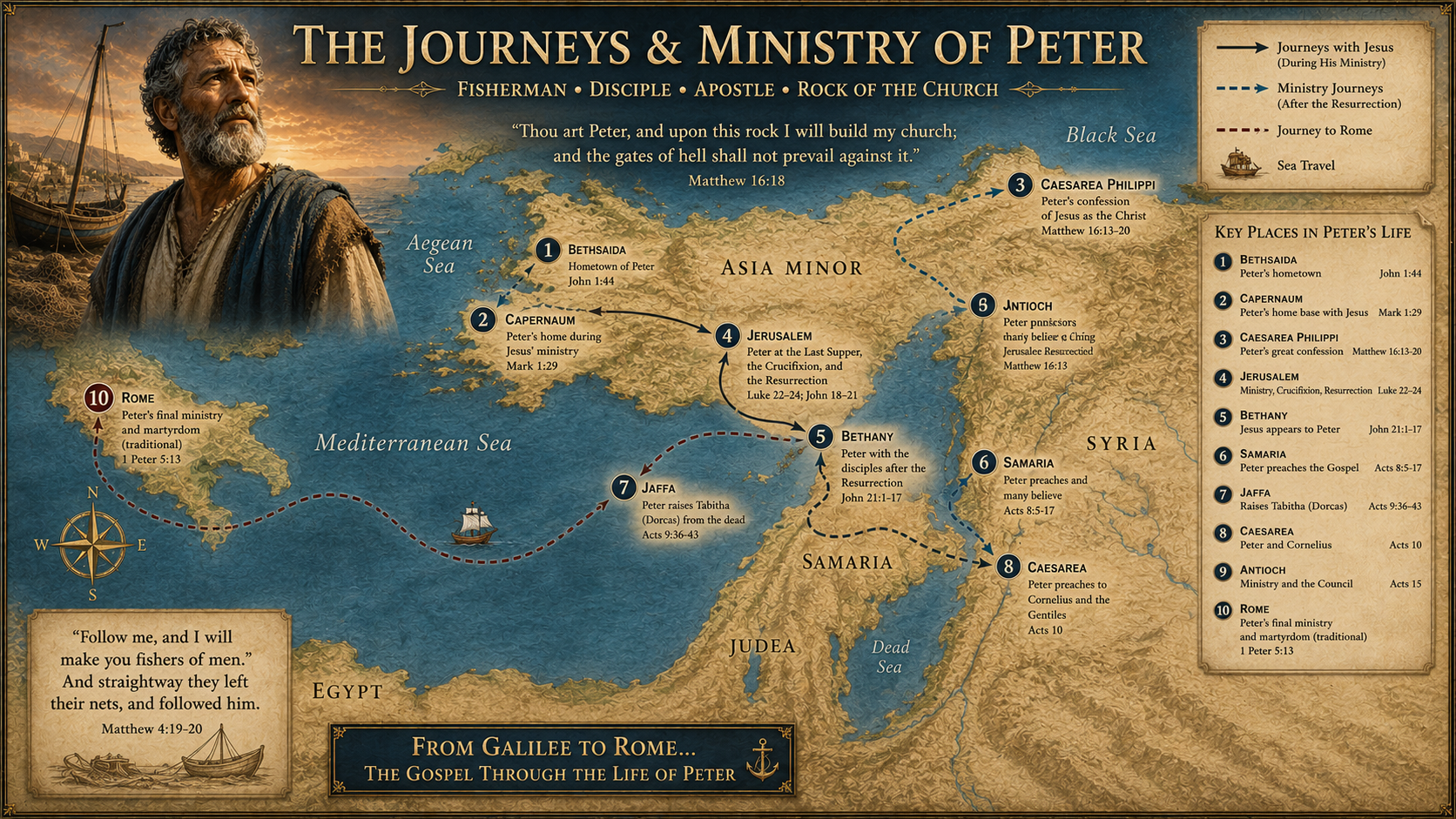
Peter was the son of Jonas, also called John in some passages, and the brother of Andrew. He was associated with Bethsaida and later lived in Capernaum, where he worked as a fisherman. Fishing on the Sea of Galilee demanded endurance, practical skill, cooperation, and familiarity with sudden storms. Peter’s occupation helps explain the physical courage, direct speech, and action-oriented temperament visible throughout his life.
Peter was married. The Gospels mention his wife’s mother, whom Jesus healed of a fever in Peter’s house. Paul later referred to Cephas as an apostle who had the right to travel with a believing wife. Scripture gives few details about Peter’s home life, but it is clear that following Christ affected not only his work but also his household and relationships.
Called to Follow Christ
Andrew first brought Simon to Jesus after hearing John the Baptist identify Christ. Jesus looked upon Simon and declared that he would be called Cephas. Later, beside the Sea of Galilee, Jesus called Peter and Andrew to leave their nets and become fishers of men. Luke records a miraculous catch of fish that brought Peter to a deep awareness of his sinfulness. Instead of rejecting him, Jesus told him not to fear and promised that from that time forward he would catch men. Peter and his partners left their former way of life to follow the Lord.
“Depart from me; for I am a sinful man, O Lord. ... Fear not; from henceforth thou shalt catch men.” — Luke 5:8, 10 (KJV)
Learning as a Disciple
Peter’s discipleship was active, personal, and often public. He watched Jesus teach crowds, calm storms, heal the sick, cleanse lepers, raise the dead, and exercise authority over demons. He asked questions that opened the way for important instruction, sometimes spoke with remarkable faith, and at other times revealed how much he still misunderstood.
During a storm on the Sea of Galilee, Peter asked Jesus to command him to come across the water. He stepped out of the boat and walked toward Christ, but when he focused on the wind and waves he became afraid and began to sink. His cry, “Lord, save me,” was answered immediately. This incident captures much of Peter’s character: genuine faith, bold initiative, human fear, and the saving hand of Christ.
At Caesarea Philippi, Peter gave his great confession that Jesus was the Christ, the Son of the living God. Soon afterward, however, he rebuked Jesus for teaching that He must suffer and die. Peter desired the glory of the kingdom but did not yet understand the necessity of the cross. Jesus corrected him severely and taught that true discipleship requires self-denial, cross-bearing, and following Him.
The Inner Circle
Peter, James, and John were present when Jesus raised Jairus’s daughter. They accompanied Him onto the mountain of transfiguration, where Peter saw the Lord’s glory and heard the Father’s voice. Peter responded impulsively by suggesting three tabernacles, placing Moses and Elijah alongside Christ, but the heavenly voice directed attention to Jesus alone: “This is my beloved Son: hear him.” Years later, Peter referred to this event as eyewitness confirmation of Christ’s majesty.
The Last Supper and Gethsemane
At the Last Supper, Peter resisted when Jesus prepared to wash his feet. After the Lord explained that the washing symbolized necessary fellowship and cleansing, Peter swung to the opposite extreme and asked for his hands and head to be washed also. His response again revealed a wholehearted but poorly measured devotion.
When Jesus warned that the disciples would be scattered, Peter insisted that he would remain faithful even unto death. Jesus knew Peter more fully than Peter knew himself. He foretold that before the cock crowed, Peter would deny Him three times. Yet the Lord also declared that He had prayed for Peter and commanded him, after he was converted or restored, to strengthen his brethren.
In Gethsemane, Peter failed to watch and pray. When the arresting party arrived, he drew a sword and cut off the ear of the high priest’s servant. Jesus stopped the violence and healed the wounded man. Peter was willing to fight with a weapon, but he was not yet prepared to endure the shameful path by which Christ would accomplish redemption.
Denial and Bitter Weeping
After Jesus was arrested, Peter followed at a distance into the high priest’s courtyard. There, under repeated questioning, he denied three times that he knew Jesus. His denials grew stronger until he began to curse and swear. When the cock crowed, the Lord turned and looked upon him. Peter remembered the warning and went out weeping bitterly.
Peter’s denial was not a minor mistake. It exposed the danger of self-confidence, spiritual carelessness, fear of people, and following Christ at a distance. Yet his tears also revealed genuine repentance. Judas felt remorse and despaired, but Peter was preserved by the intercession of Christ and brought through failure into restoration.
The Resurrection and Restoration
On the morning of the resurrection, Peter ran with John to the empty tomb. The risen Christ appeared personally to Peter, though Scripture does not record the details of that meeting. Later, beside the Sea of Galilee, Jesus publicly restored him. Three times the Lord asked, “Lovest thou me?” and three times commanded him to feed or tend His sheep. The threefold commission answered Peter’s three denials, but restoration did more than erase shame. It entrusted Peter with responsibility for Christ’s people.
“Simon, son of Jonas, lovest thou me? ... Feed my sheep.” — John 21:17 (KJV)
Witness at Pentecost
After Christ’s ascension, Peter took a leading role among the disciples. He directed the gathering that selected Matthias to fill the vacant apostolic place. On the day of Pentecost, when the Holy Ghost was poured out, Peter stood with the Eleven and explained the event from Scripture. He proclaimed Jesus as crucified, risen, exalted, and made both Lord and Christ. About three thousand souls received the word and were baptized.
The man who had denied Jesus before a servant girl now preached Him before a multitude. This transformation cannot be explained merely as improved self-confidence. Peter had seen the risen Christ, had been restored by Him, and had received power through the Holy Ghost. His boldness was now rooted in truth rather than in boasting.
Leadership in the Early Church
Peter and John healed a man who had been lame from birth at the gate of the temple called Beautiful. Peter refused personal glory and declared that the miracle had been accomplished through faith in the name of Jesus Christ. When the rulers commanded the apostles to stop speaking in that name, Peter answered that they could not but speak the things they had seen and heard.
Peter confronted deception within the church in the case of Ananias and Sapphira. He traveled among believers, healed Aeneas at Lydda, and raised Dorcas at Joppa. These events displayed the continuing work of the risen Christ through His servants and strengthened the growing church.
The Gospel Opens to the Gentiles
While staying in Joppa, Peter received a vision in which he was commanded not to call common what God had cleansed. At the same time, messengers arrived from Cornelius, a Roman centurion in Caesarea. Peter entered the Gentile household and preached Jesus Christ as Lord, crucified and raised from the dead. While he spoke, the Holy Ghost fell upon the Gentile hearers. Peter then commanded them to be baptized.
This was a major turning point. Peter learned that God is no respecter of persons and that everyone who believes in Christ receives remission of sins. When Jewish believers questioned his actions, Peter explained the vision and the Spirit’s work. They glorified God, recognizing that repentance unto life had also been granted to the Gentiles.
Persecution, Deliverance, and Later Ministry
Herod Agrippa I imprisoned Peter and intended to execute him after Passover. The church prayed without ceasing, and an angel delivered Peter from the prison during the night. Peter then withdrew from Jerusalem for a time. He later appeared at the Jerusalem council, where he reminded the assembly that God had chosen to bring the gospel to the Gentiles through his preaching and had purified their hearts by faith.
The New Testament records less detail about Peter’s later travels. Paul mentions meeting him in Jerusalem and later confronting him at Antioch when Peter withdrew from eating with Gentile believers because he feared a circumcision party. Even after years of ministry, Peter could still yield to pressure. Paul’s correction protected the truth that Jewish and Gentile believers are justified by faith in Christ, not by works of the law.
Peter’s first epistle identifies him as an apostle of Jesus Christ and addresses believers scattered across several regions of Asia Minor. His reference to “the church that is at Babylon” has been interpreted in different ways. Many Christians through history have understood Babylon as a symbolic reference to Rome, while others have taken it as a literal location. Scripture does not provide enough information to reconstruct every stage of his later travels with certainty.
Early Christian tradition consistently connects Peter’s final ministry and martyrdom with Rome during the persecution under Nero. The Bible does not describe his death, but Jesus had foretold that Peter would glorify God through a death in which others would stretch forth his hands and carry him where he would not choose to go. Peter’s own second epistle shows that he knew the putting off of his earthly tabernacle was near.
Major Contributions
Eyewitness of Jesus Christ
Peter’s first great contribution was his witness to the person and work of Jesus. He knew Christ in ordinary settings, on roads, in homes, upon the sea, before crowds, and in private instruction. He saw both the Lord’s humility and His glory. He witnessed miracles, heard the kingdom teaching, observed the crucifixion events from a place of failure, and afterward saw the risen Christ. His preaching rested upon events he had personally witnessed rather than upon religious speculation.
Confession of Christ
Peter gave one of Scripture’s clearest confessions of Jesus’s identity: “Thou art the Christ, the Son of the living God.” This confession became central to apostolic preaching. Peter did not merely present Jesus as a teacher, prophet, moral example, or political liberator. He proclaimed Him as the promised Messiah, the Holy One, the Prince of life, the Lord of all, and the only name under heaven given among men whereby we must be saved.
Preaching the Resurrection
In Acts, Peter repeatedly announced that God raised Jesus from the dead. The resurrection proved that death could not hold Christ, confirmed His identity, established His exaltation, and offered forgiveness and life to those who repent and believe. Peter’s sermons joined the facts of Christ’s death and resurrection with Old Testament prophecy and a direct call for response.
Opening the Gospel Door
Peter played a leading role in three important expansions of the church’s witness. He preached to Jews and proselytes at Pentecost, participated with John when Samaritan believers received the Holy Ghost, and preached in the Gentile home of Cornelius. In this way, his ministry visibly accompanied the gospel’s movement outward in keeping with Christ’s command.
Shepherding Suffering Believers
Peter’s letters contributed lasting pastoral instruction. First Peter presents believers as strangers and pilgrims who possess a living hope through the resurrection. It teaches them to live holy lives, submit where obedience to God permits, endure unjust suffering, resist the devil, and entrust themselves to the faithful Creator. Peter repeatedly directs suffering Christians to Christ, who suffered without sin and then entered glory.
Warning Against False Teaching
Second Peter urges believers to add virtue, knowledge, temperance, patience, godliness, brotherly kindness, and charity to their faith. It warns that false teachers may use covetousness, sensuality, and deceptive words to exploit others. Peter anchors the church in the prophetic Scriptures and apostolic eyewitness, declaring that holy men of God spoke as they were moved by the Holy Ghost.
A Living Example of Restoring Grace
Peter’s failures became part of his contribution because Scripture does not conceal them. Believers see in him that serious sin must never be excused, but neither must a repentant disciple believe that failure places him beyond Christ’s restoring mercy. Peter could later strengthen weak believers because he knew both the pain of collapse and the faithfulness of the Savior who prayed for him.
Family and Important Relationships
Andrew
Andrew was Peter’s brother and the person who first brought him to Jesus. Although Peter became more prominent in the narrative, Andrew’s quiet act of invitation had enormous consequences. Their relationship reminds believers that the person who brings another to Christ may never foresee how greatly God will use that life.
Peter’s Wife and Household
Peter’s marriage is confirmed by the healing of his mother-in-law and by Paul’s reference to his right to travel with a believing wife. The demands of apostolic ministry therefore affected a real household. Peter’s first epistle also contains careful instruction to husbands and wives, calling husbands to dwell with their wives according to knowledge and to honor them as heirs together of the grace of life.
James and John
Peter often ministered alongside James and John. The three shared privileged moments of revelation as well as failures of understanding. They formed the inner circle, but their access was intended to prepare them for service, not personal superiority.
John
Peter and John appear together frequently. They ran to the empty tomb, ministered at the temple, stood before the council, and traveled to Samaria. Their personalities differed, but the Lord joined them in witness. John later recorded Peter’s restoration in detail.
Paul
Paul visited Peter in Jerusalem and recognized his ministry among the circumcision. Their callings differed in emphasis, yet they preached the same gospel. The Antioch confrontation demonstrates that apostolic leaders were accountable to revealed truth. Peter’s later reference to Paul as “our beloved brother Paul” suggests respect despite correction and acknowledges the wisdom given to Paul.
Mark
Peter called Mark his son, probably indicating a close spiritual relationship. Early Christian testimony strongly associates Mark’s Gospel with Peter’s preaching and recollections. While that connection lies outside the direct statements of Scripture, the biblical text clearly shows that Peter and Mark shared a meaningful bond in ministry.
Cornelius
Cornelius represented a boundary Peter had not expected to cross. Through this Gentile centurion’s household, God taught Peter and the wider church that the gospel cleanses believers by faith and creates one people in Christ.
Character Qualities
Courage
Peter possessed real courage. He stepped out of the boat, drew a sword when Jesus was arrested, preached publicly after Pentecost, and faced religious authorities who threatened him. His courage was initially mixed with self-confidence and misunderstanding, but the Holy Ghost turned it into steadfast witness.
Teachability
Although Peter often needed correction, he remained with Christ and continued learning. He accepted the Lord’s rebukes, received the lesson of the Gentile vision, explained his actions to concerned believers, and later accepted Paul’s place in the church. A teachable person is not one who never errs, but one who submits to truth when corrected.
Love for Christ
Peter’s love was imperfect but genuine. He wanted to remain near Jesus, grieved when his devotion was questioned, and ultimately spent his life proclaiming the Lord he once denied. Christ purified Peter’s love by separating it from boasting and joining it to humble service: “Lovest thou me? Feed my sheep.”
Leadership
Peter was willing to speak and act when others hesitated. This made him influential, but leadership also magnified his errors. Under Christ’s training, he learned that spiritual leaders must serve, suffer, watch over souls, and refuse to lord themselves over God’s heritage.
Humility Learned Through Failure
Peter did not begin as a consistently humble man. He compared his loyalty with that of others and trusted his own resolve. His denial broke that confidence. In his first epistle, he urged believers to be clothed with humility and reminded elders that God resists the proud but gives grace to the humble. The counsel came from experience.
Compassion and Pastoral Concern
The Peter of the epistles speaks tenderly to scattered, pressured believers. He calls them elect, beloved, living stones, a chosen generation, and the flock of God. His writing reflects the shepherding commission given beside the sea.
Impulsiveness
Peter frequently spoke before fully understanding. He proposed building tabernacles at the transfiguration, resisted the washing of his feet, promised a loyalty he could not sustain, and used a sword in Gethsemane. Zeal without spiritual understanding can create confusion or harm.
Fear of People
Fear contributed to Peter’s denial and later to his withdrawal from Gentile fellowship at Antioch. These incidents warn that even experienced believers may compromise when acceptance, reputation, or safety appears threatened.
Capacity for Repentance
One of Peter’s most hopeful qualities was his willingness to return. He wept bitterly, received restoration, and resumed service. Repentance did not erase the seriousness of his sin, but it placed him again under the transforming grace of Christ.
Lessons from Peter
Christ Calls Ordinary People
Peter did not begin as a scholar, priest, ruler, or polished religious leader. He was a working fisherman. Christ’s call demonstrates that usefulness in God’s kingdom depends upon His grace and training rather than upon social position. Natural abilities may be employed, but they must be surrendered to the Lord.
Spiritual Insight Does Not Eliminate the Need for Growth
Peter could confess Christ accurately and still resist the cross moments later. Believers should not assume that one correct insight means they understand every implication of the truth. Discipleship requires continuing submission to all that Christ teaches.
Self-Confidence Is Not the Same as Faith
Peter’s bold promises failed because they rested upon his own strength. True faith looks to Christ, watches and prays, receives strength from the Spirit, and refuses to boast over others. A believer may sincerely intend to stand and still fall if he neglects dependence upon God.
Failure Need Not Be Final
Peter’s denial was grievous, but Christ had prayed for him and restored him. This does not encourage careless sin. It encourages repentant believers to return to the Savior rather than surrender to hopelessness. Christ can use a humbled disciple more deeply than a self-assured one.
Restoration Leads to Responsibility
Jesus did not restore Peter merely so that he could feel better about himself. He commanded him to feed the sheep. Grace comforts the fallen, but it also calls them back to obedience, service, and care for others.
The Resurrection Creates Bold Witnesses
Peter’s courage after Pentecost flowed from the certainty that Jesus had risen and reigns. The church’s witness is not built on vague inspiration but on the historical gospel of Christ’s death, burial, resurrection, exaltation, and promised return.
God Shows No Partiality
Peter had to learn that no ethnic, ceremonial, or social boundary could exclude those whom God cleansed through faith in Christ. The church must not rebuild walls that the gospel has removed.
Suffering Can Be Faithful, Not Shameful
Peter once feared association with a suffering Messiah. Later he taught believers not to be ashamed when suffering as Christians. He learned that suffering in obedience may unite believers with Christ’s example and will ultimately give way to glory.
Leaders Remain Accountable to Truth
Peter’s correction at Antioch shows that reputation cannot place any leader beyond biblical accountability. The truth of the gospel is greater than personality, office, influence, or tradition.
Believers Must Watch for False Teachers
Peter warned that destructive teaching often travels with pride, greed, sensuality, and contempt for authority. Christians must grow in knowledge of Christ and remain anchored in the written Word.
The Lord’s Delay Is Mercy
Second Peter teaches that the apparent delay of Christ’s return does not mean that God has forgotten His promise. The Lord is longsuffering, giving opportunity for repentance. Because the day of the Lord will come, believers should live in holiness, godliness, watchfulness, and hope.
Peter’s Writings
First Peter
First Peter is addressed to believers described as strangers scattered across Pontus, Galatia, Cappadocia, Asia, and Bithynia. The letter joins suffering with hope. Believers have been begotten again unto a living hope by the resurrection of Jesus Christ and await an incorruptible inheritance reserved in heaven.
The epistle calls Christians to holiness because God is holy. It describes them as living stones built into a spiritual house and as a chosen generation called to show forth God’s praises. It gives instruction concerning civil order, servants, marriage, relationships within the church, spiritual gifts, persecution, and elder leadership. Christ’s suffering is repeatedly presented as both the basis of salvation and the supreme example of righteous endurance.
“Who his own self bare our sins in his own body on the tree, that we, being dead to sins, should live unto righteousness.” — 1 Peter 2:24 (KJV)
Second Peter
Second Peter was written with the awareness that Peter’s death was approaching. He desired to leave believers a lasting remembrance of apostolic truth. The letter emphasizes growth in grace and knowledge, confidence in inspired prophecy, resistance to false teachers, certainty of divine judgment, and expectation of the new heavens and new earth.
Peter insists that the apostles did not follow cunningly devised fables. He appeals to the transfiguration as eyewitness testimony and to the more sure word of prophecy. He closes by warning believers not to be led away with error but to grow in the grace and knowledge of Jesus Christ.
Key Scriptures Connected with Peter
Matthew 4:18-20 — Jesus calls Peter and Andrew to become fishers of men.
Matthew 14:28-31 — Peter walks on the water, fears, and is rescued by Christ.
Matthew 16:13-23 — Peter confesses Jesus as the Christ and is corrected concerning the cross.
Matthew 17:1-8 — Peter witnesses the transfiguration.
Luke 5:1-11 — The miraculous catch and Peter’s call.
Luke 22:31-34 — Christ prays for Peter and foretells his denial.
Luke 22:54-62 — Peter denies Jesus and weeps bitterly.
John 20:1-10 — Peter and John run to the empty tomb.
John 21:15-19 — Jesus restores Peter and commands him to feed the sheep.
Acts 2:14-41 — Peter preaches at Pentecost.
Acts 3:1-26 — The lame man is healed and Peter preaches Christ.
Acts 4:8-20 — Peter testifies boldly before the rulers.
Acts 10:1-48 — Peter preaches to Cornelius and the Gentiles receive the Holy Ghost.
Acts 12:1-19 — Peter is delivered from prison by an angel.
Acts 15:7-11 — Peter speaks at the Jerusalem council.
Galatians 2:11-16 — Paul corrects Peter at Antioch.
1 Peter 1:3-9 — Living hope through Christ’s resurrection.
1 Peter 2:21-25 — Christ’s suffering and substitution.
1 Peter 5:1-10 — Shepherding, humility, vigilance, and grace.
2 Peter 1:12-21 — Apostolic eyewitness and inspired prophecy.
2 Peter 3:8-18 — The Lord’s patience, coming judgment, and call to holy living.
Legacy
Peter’s influence stretches from the shores of Galilee through the entire history of the church. He is remembered as a fisherman called by Christ, a disciple who spoke boldly, an apostle who failed publicly, a restored shepherd, a Pentecost preacher, a witness to Jews and Gentiles, and an author who strengthened suffering believers.
His legacy does not rest upon the idea that Peter was flawless. Scripture deliberately preserves his mistakes. His life is powerful because it displays what Jesus Christ can do with a willing but imperfect person. Peter’s natural boldness had to be humbled, his self-confidence broken, his understanding corrected, and his love purified. Afterward, the same man who trembled before accusation could stand before rulers and declare that salvation is found in Jesus alone.
Peter also helped the early church understand its identity. Through his preaching and experience, the church learned that the risen Christ pours out the Holy Ghost, forgives repentant sinners, heals and saves through His name, and brings believing Jews, Samaritans, and Gentiles into one redeemed people. Through his letters, generations of Christians have learned how to endure suffering, honor Christ as Lord, shepherd God’s flock, resist the devil, recognize false teachers, and wait for the Lord’s return.
The central figure in Peter’s story is not Peter himself but Jesus. Christ called him, named him, corrected him, rescued him, prayed for him, forgave him, restored him, commissioned him, empowered him, and promised to receive glory through his death. Peter’s life therefore points beyond human leadership to the faithful Shepherd and Bishop of souls.
“But the God of all grace, who hath called us unto his eternal glory by Christ Jesus, after that ye have suffered a while, make you perfect, stablish, strengthen, settle you.” — 1 Peter 5:10 (KJV)
Summary
Peter’s story is the story of a disciple transformed by the grace of Christ. He began as Simon the fisherman: energetic, outspoken, loyal in intention, yet unstable under pressure. He became Peter the apostle: humbled by failure, restored by love, strengthened by the Holy Ghost, and devoted to proclaiming the crucified and risen Lord.
His life teaches that Christ sees not only what His followers are but what His grace can make them. Peter’s weakness warns believers against pride and self-reliance. His repentance encourages those who have fallen. His restoration demonstrates the mercy of the Savior. His preaching establishes the gospel. His ministry to Cornelius displays the breadth of grace. His letters call the church to holiness, courage, humility, vigilance, and hope.
Peter remained a man with limitations, but he belonged to a perfect Savior. His lasting testimony can be summarized in the confession that shaped his life and ministry: Jesus is the Christ, the Son of the living God.