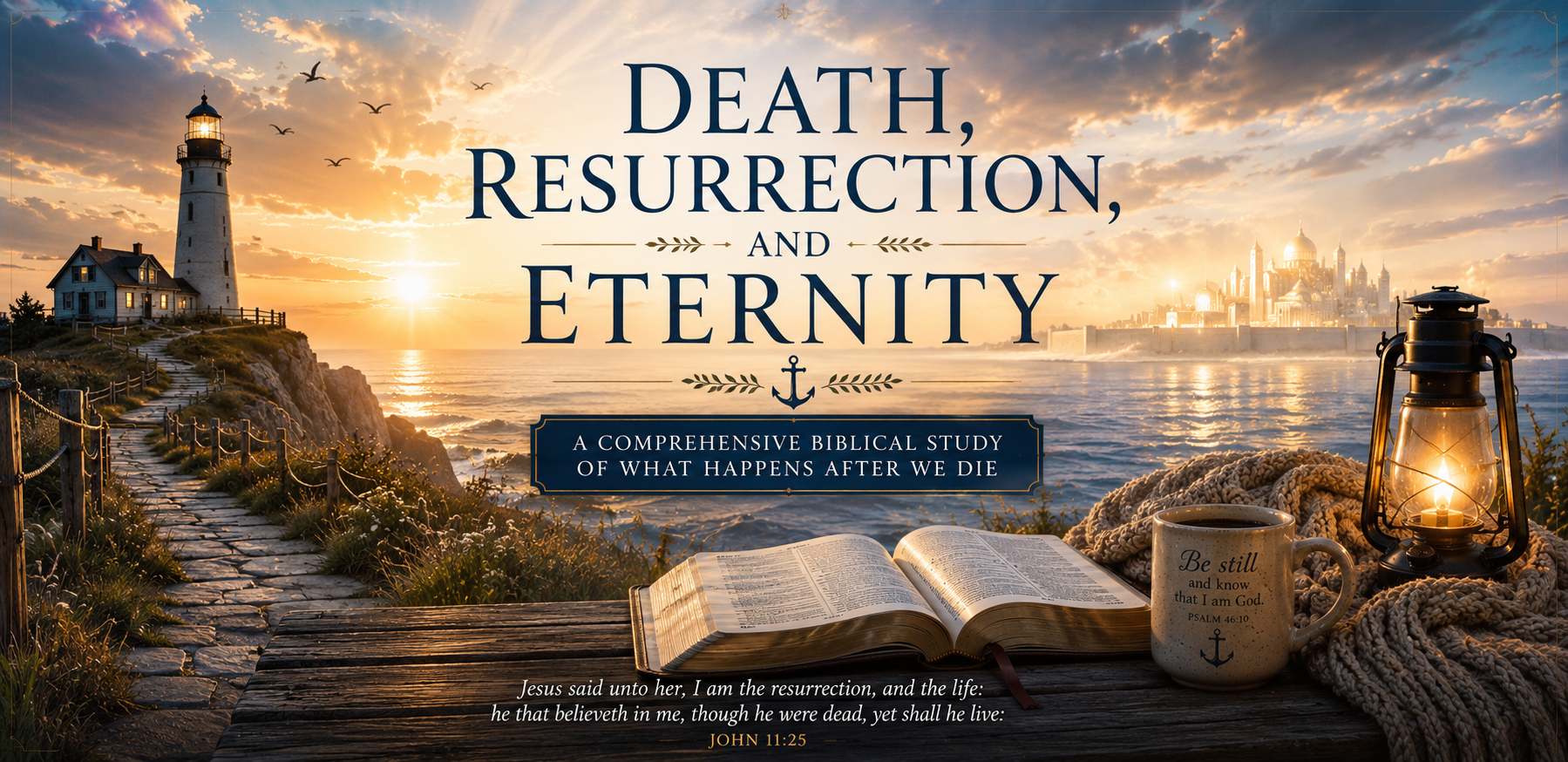
October 3-7 | Starting at $500Chapter 2 — Does the Soul Sleep?
Introduction
Few questions have generated more discussion among Christians than whether believers remain conscious after death or whether they "sleep" until the resurrection. Throughout church history, sincere believers have arrived at different conclusions because the Bible frequently uses the word sleep when speaking about those who have died.
Does Scripture mean that the soul becomes unconscious?
Or is "sleep" simply a figure of speech describing the body's temporary condition while awaiting resurrection?
This chapter examines every major passage commonly cited in support of soul sleep and compares each one with the broader testimony of Scripture. Our goal is not to defend a denomination or tradition but to discover how the Bible itself uses this language.
Why Does Scripture Use the Word "Sleep"?
One of the first observations we must make is that the Bible often uses figurative language.
Throughout Scripture we read phrases such as:
"He slept with his fathers."
"Those who sleep in the dust."
"Many are asleep."
"Our friend Lazarus sleepeth."
None of these passages immediately define whether the soul is conscious or unconscious. Instead, they describe death from the perspective of the physical body.
Just as a sleeping person appears peaceful and awaits awakening, so the body of the believer rests in the grave awaiting the resurrection.
Word Study — "Sleep"
Hebrew
יָשֵׁן (Yashen)
Meaning:
to sleep
to lie down
to rest
The Hebrew word itself simply describes sleep or resting. When used concerning death, context determines whether it is literal sleep or a metaphor for physical death.
Greek
κοιμάω (Koimaō)
Meaning:
to sleep
to cause to lie down
to fall asleep
This is the word most frequently used in the New Testament regarding deceased believers.
From this word we derive the English word cemetery, which comes from the Greek koimētērion, literally meaning "a sleeping place."
The early Christians intentionally chose this word because they viewed the grave as temporary, not permanent.
Daniel's Prophecy
One of the most well-known passages appears in Daniel.
"And many of them that sleep in the dust of the earth shall awake, some to everlasting life, and some to shame and everlasting contempt."
Daniel 12:2 (KJV)
Notice what Daniel actually says.
Those who sleep are described as being in the dust of the earth.
The emphasis is on the body resting in the grave.
Daniel does not attempt to describe the present condition of the soul. His attention is fixed upon the future resurrection.
Jesus and Lazarus
Perhaps the clearest explanation comes from Jesus Himself.
"Our friend Lazarus sleepeth; but I go, that I may awake him out of sleep."
John 11:11 (KJV)
The disciples misunderstood Him.
"Then said his disciples, Lord, if he sleep, he shall do well."
John 11:12 (KJV)
John immediately explains:
"Howbeit Jesus spake of his death: but they thought that he had spoken of taking of rest in sleep."
John 11:13 (KJV)
Then Jesus removed every uncertainty.
"Then said Jesus unto them plainly, Lazarus is dead."
John 11:14 (KJV)
Here Scripture itself defines the metaphor.
Sleep is another way of referring to physical death.
Jesus was not teaching that Lazarus had become unconscious.
Rather, He was using a familiar Jewish expression describing death as temporary because resurrection was coming.
Paul's Teaching
Paul also uses this language.
"But I would not have you to be ignorant, brethren, concerning them which are asleep..."
1 Thessalonians 4:13 (KJV)
A few verses later he explains:
"The dead in Christ shall rise first."
1 Thessalonians 4:16 (KJV)
Notice Paul's concern.
He is comforting grieving believers by assuring them that those who have died will participate fully in Christ's return.
The passage focuses upon resurrection, not upon proving whether the soul is conscious or unconscious between death and resurrection.
Does "Sleep" Mean Unconsciousness?
Some Christians believe these passages teach that believers remain entirely unconscious until Christ returns.
Others point to passages such as:
"To day shalt thou be with me in paradise."
Luke 23:43 (KJV)
and
"Absent from the body...present with the Lord."
2 Corinthians 5:8 (KJV)
These verses appear to describe conscious fellowship with Christ immediately after death.
Rather than forcing one group of verses to contradict another, we must ask whether they are describing different aspects of the believer's experience.
Many Bible scholars conclude that the body sleeps in the grave while the believer's spirit remains alive in God's presence, awaiting the future resurrection of the body.
This interpretation allows every passage to retain its natural meaning without contradiction.
Historical Perspective
The overwhelming majority of early Church Fathers understood "sleep" as referring primarily to the body.
Among those who interpreted these passages this way were:
Ignatius of Antioch
Irenaeus
Tertullian
Augustine
Later Reformers such as Martin Luther occasionally used the language of sleep devotionally, yet the mainstream Protestant tradition has generally understood the believer to be consciously with Christ while awaiting bodily resurrection.
A smaller number of groups throughout history have defended the doctrine commonly called Soul Sleep or Psychopannychism, arguing that consciousness ceases until the resurrection.
Both positions deserve careful examination, but they must always remain subject to Scripture rather than tradition.
Scripture Interpreting Scripture
As we compare every relevant passage, a consistent pattern begins to emerge.
The Bible repeatedly teaches:
the body dies,
the body rests in the grave,
resurrection is future,
Christ's victory guarantees that death is temporary for believers.
Whether the believer's spirit enjoys conscious fellowship with Christ during this interval will become even clearer as we examine Paradise, Abraham's Bosom, and Paul's statements about being with the Lord.
Summary
The biblical expression "sleep" is consistently connected with physical death and the future resurrection.
The word itself does not automatically prove unconsciousness.
Instead, it emphasizes the temporary nature of death for God's people.
Because Christ conquered death, the grave is not the believer's permanent home.
The resurrection morning is coming.
Key Scriptures
Daniel 12:2
John 11:11–14
Acts 7:60
1 Corinthians 15:6
1 Corinthians 15:18–20
1 Thessalonians 4:13–18
Matthew 27:52
Luke 23:43
2 Corinthians 5:8
Reflection
The Bible's language of sleep reminds believers that death is temporary. Just as sleep is followed by awakening, so every believer who belongs to Christ awaits the glorious day when mortality will put on immortality. Our hope is not found in avoiding death but in belonging to the One who has already conquered it.
"But thanks be to God, which giveth us the victory through our Lord Jesus Christ."
1 Corinthians 15:57 (KJV)